

Many lives, one shared space. A Madhubani-style kohabar drawing from Bihar, India, brings together people, animals and plants within a single composition – a visual reflection that different forms of life can occupy and shape the same world. PC: https://www.britishmuseum.org/collection/image/155858001
Think of a busy city and the chaos it holds. A city works because not everyone is trying to do exactly the same thing. People may share the same streets, buildings and resources, while their roles in the society are not always neatly separated. We see both possibilities around us: people competing for similar opportunities (think of two restaurants in the same neighbourhood serving great Italian food) and people occupying entirely different professions, developing different skills and depending on different parts of a larger system. A baker, an engineer and a doctor can all live in the same neighbourhood without competing for precisely the same role. Even when people depend on similar resources, differences in what they do and how they use those resources can reduce direct competition. By taking on different roles and responsibilities, people are able to share the same social space without competing in similar ways.
Natural communities of plants or animals can be visualised much like a busy city, facing the intricacies of a similar puzzle. In a city, much of this competition occurs among humans, i.e. among individuals of the same species. When we think of ecological communities, different species could also compete with one another when they depend on the same limited resources. Some species occupy very different roles and rely on different resources, while others share similar habitats, experience similar environmental conditions and depend on overlapping resources, yet continue to coexist.
It is this second situation that becomes particularly interesting, where some of these species may be closely related, similar in size and capable of feeding on the same kinds of prey. When species have such similar ecologies and rely on overlapping resources, what allows them to coexist in the same space?
The competitive exclusion principle in ecology, at its core, proposes that complete competitors cannot coexist indefinitely. A study by Clark et al. offers striking examples of what this can look like. On rocky Scottish shores, there exist two barnacle species Chthamalus and Balanus, competing for the limited space available on the rocks. Barnacles are small marine crustaceans that spend their adult lives fixed firmly to hard surfaces. Once they settle, they cannot simply move elsewhere, so every patch of rock becomes valuable real estate.
The shores that barnacles inhabit are divided into zones depending on how long each area remains underwater during the tidal cycle. The lower shore is submerged for longer and is therefore wetter, while the upper shore spends much more time exposed to air, heat and the risk of drying out. Balanus grows faster and is the stronger competitor for space in the lower shore, where it can crowd out and effectively exclude Chthamalus. Interestingly, when Balanus was experimentally removed, Chthamalus expanded towards the lower shore, showing that it was competition and not an inability to survive there that had been restricting it.
In regular conditions, Chthamalus survives higher on the shore because it is more tolerant of heat and drying, conditions that Balanus handles poorly. In effect, the harsh upper shore provides Chthamalus with a refuge from its stronger competitor. This is precisely why the word “complete” matters in the competitive exclusion principle: Chthamalus may lose to Balanus on the lower shore, but the two species do not compete equally everywhere. Higher on the shore, conditions favour Chthamalus, allowing it to survive alongside its stronger competitor. Chthamalus may lose the competition in one part of the shore, but environmental differences change the balance elsewhere.
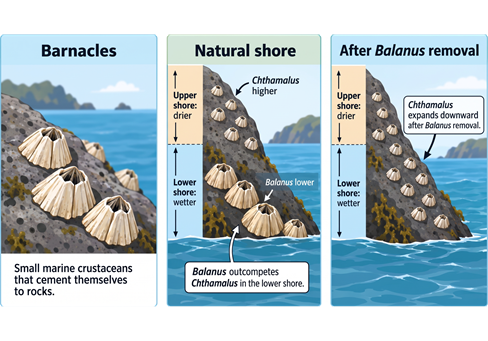
Figure 1: Competition on a crowded shore between Balanus and Chthamalus. Based on Conell,1961, Created in https://BioRender.com
Understanding competition
Competition does not always end with one species being pushed out completely. Sometimes, more competition can make being different an advantage. When two species depend heavily on the same limited resources, individuals that use those resources somewhat differently may face less direct competition, and, therefore, fare better.
Individuals within a population could be different from each other in their traits, behaviour, etc. Now if some of those differences help them avoid direct competition or are advantageous, these individuals may survive or reproduce more successfully. Over generations, such traits can become more common in the population. When resources overlap strongly, traits and behaviours that reduce direct competition may be favoured over generations.
Multiple examples across ecosystems demonstrate this beautifully. Experiments with stickleback fish showed that when a closely related competitor was introduced, individuals with different feeding-related traits grew better. When the fish lived alone, however, there was no consistent advantage to having those differences. In the presence of a competitor, specialising on a different resource could reduce competition, even if becoming better at one way of feeding meant becoming less efficient at another.
In other words, it was the presence of a competitor that made being different beneficial. The importance of competition extends far beyond sticklebacks. From early models of competitive exclusion to modern theories of coexistence, competition has remained one of the key processes ecologists use to understand how species interact, diverge and persist together. Competition, then, can do more than determine who wins and who loses – it can favour different ways of making a living. And, it is through such differences that one possible path for coexistence begins to emerge.
Ecologists call this niche partitioning. Simply put, this happens when species living in the same community reduce direct competition by using resources, space or time in different ways. Think again of the two Italian restaurants in the same neighbourhood. One might change its specials, focus on a particular style of cuisine or appeal to a different group of customers. Both still operate in the same neighbourhood and may draw from a broadly similar customer base, but they are no longer competing in the same way. Similarly, species can continue to share much of the same environment while differing in how they use it, reducing the extent of direct competition between them.
There are many examples of this pattern in nature. Darwin’s finches may differ in the food they eat. Two Anolis lizard species can share the same vegetation while using it differently—one spending more time on the ground or lower perches, while the other occupies higher perches. In other communities, species may divide time rather than space, becoming active at different hours of the day. What these examples show is that coexistence does not always require completely different lifestyles. Species can share much of the same environment while differing in only a few aspects of how they make a living.
Sometimes, however, differences in how species use their environment can become more established over evolutionary time. Species may become particularly well suited to certain resources, habitats or ways of making a living, known as ecological specialisation. Ecological specialisation can develop for many reasons, and competition between species can sometimes favour such differences. The important point is that unlike the more flexible differences described earlier, these differences can become more lasting over time. Ecological specialisation has, indeed, been documented across a remarkable range of organisms across many dimensions. This could range from resources (diet) and habitat use to interactions with other species. Importantly, it is not an all-or-nothing condition: species can fall anywhere along a continuum from broad generalists to highly specialised forms.
Most of the examples so far involve differences that are relatively easy to observe or measure, where an animal forages, when it is active, or which part of a habitat it uses. But some differences may be hidden or difficult to measure; for example, animals which either live in soil or leaf litter. One such group of organisms are centipedes, which are nocturnal, meaning that much of their foraging happens at night, and they feed relatively infrequently. This makes their feeding behaviour difficult to observe and measure directly. Centipedes are venomous and use venom to paralyse their prey; so a difference may lie in their venom. The constituents of venom can influence how prey are captured and subdued, making venom an important part of how these animals make a living. Different venom compositions may, therefore, provide predators with different functional possibilities, even when they occupy the same habitat. This raises an intriguing question: when closely related predators live side by side, do their venoms resemble one another, or do they differ in the biochemical tools they use for predation?
To answer this, we, in Jahnavi Joshi’s Evolutionary Ecology Lab at CCMB, studied two large centipedes found across peninsular India: Scolopendra morsitans and Scolopendra hardwickei. The two species make an interesting pair. They are closely related, broadly similar in body size and occur across overlapping regions in the Western Ghats, providing plenty of opportunities to encounter similar environments and potentially similar resources.
Despite these overlaps in their distribution, the venom compositions of the two centipedes differ: not just in ingredients but in proportions of the ingredients. About 65.5% of the detected proteins were common to both, but differed significantly in the abundance of those components. S. morsitans also had 24 toxin proteins detected uniquely in that species, compared with four in S. hardwickei. In other words, they seemed to be working with many of the same biochemical ingredients, but assembling rather different venom recipes.
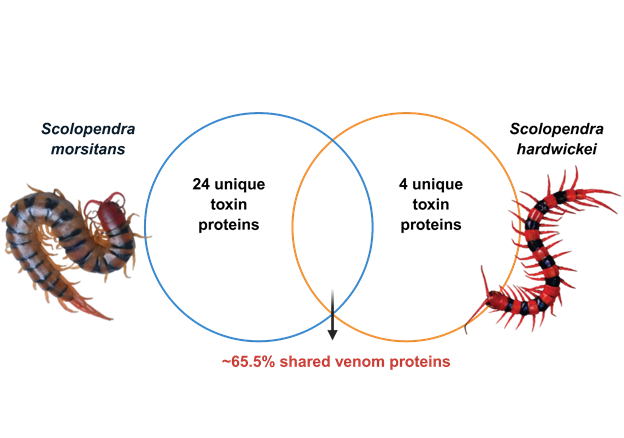
Figure 2: Shared ingredients, different venom recipes in centipedes
This finding points to venom as another possible dimension along which coexisting predators can differ. Even when species share much of the same landscape and appear similar in many respects, the molecular tools they use for predation may not be identical. Such differences could have multiple implications; potentially these changes may translate into differences in the prey they are best able to subdue, or into different levels of effectiveness against the same prey. Whether that is actually the case in these centipedes still needs to be tested experimentally.
Vasudhaiva Kutumbakam
The big picture is that coexistence of organisms may depend on a patchwork of differences, some easy to see, others hidden at the molecular level, that together allow species to share the same world without completely overlapping in how they live.
Much like our crowded city, nature does not seem to resolve competition simply by keeping everyone apart. Organisms may compete in some ways, differ in others, and sometimes even benefit from one another, all while sharing the same space.
Perhaps this is the crux of coexistence: not the absence of competition, but enough difference to keep every interaction from becoming a collision. The ancient idea of Vasudhaiva Kutumbakam “the world is one family”, captures a fitting reflection on this idea: Living together does not mean living alike, but finding ways to share the same world.