What if the next billion-dollar company is born not in a garage, but in a laboratory? Today, entrepreneurship is no longer limited to software, e-commerce, or IT. A new wave of interest is emerging from research labs in the form of biotech startups. India’s biotech ecosystem has grown dramatically, from around 50 startups in 2014 to nearly 11,000 by 2025, with the biggest acceleration occurring after the COVID-19 pandemic.
Unlike conventional startups, biotech ventures are built on scientific research, laboratory experimentation, and long development timelines. They combine scientific discovery with business strategy to address major global challenges, including disease treatment, food security, environmental sustainability, and economic development. Advances in technologies such as CRISPR, synthetic biology, and artificial intelligence/machine learning (AI/ML) have made it increasingly possible to transform scientific ideas into practical solutions.
Many of these startups are founded by young researchers and PhD scholars who work closest to emerging scientific discoveries and unmet practical needs. Their hands-on experience, willingness to challenge established approaches, high risk appetite and ability to navigate uncertainty often provide the flexibility required in early-stage innovation.
Biotech startups in health, food and environment
Healthcare and pharmaceuticals remain one of the most impactful sectors for biotechnology innovation. Startups are transforming disease diagnosis, treatment, and prevention through advances in drug discovery, gene therapy, and personalized medicine. Moderna’s mRNA based vaccines played a crucial role in the tough times of COVID-19 pandemic, which began as a startup around 2010.
Food security is another growing challenge as the global population continues to rise. Agricultural biotechnology startups aim to improve crop productivity and resilience by developing pest-resistant and climate-resilient varieties. For example, Indigo agriculture uses beneficial microbes to enhance crop tolerance to environmental stress, reduce water requirements, and improve resistance to disease.
Biotechnology is also contributing to alleviate environmental challenges. LanzaTech recycles industrial waste gases into sustainable fuels and chemicals, converting carbon-rich emissions into products such as ethanol, methanol, and biomethane. Impossible Foods is on a mission to develop cell culture-based meat substitutes that taste, smell and cook like animal meat.
The large language models in AI have transformed complex data handling in biostartups. For instance, AarogyaAI applies ML algorithms to analyze complex genomic data with greater speed, accuracy, and scalability.
These examples illustrate how biotech startups are addressing global challenges. Yet behind every successful startup lies a long journey of experimentation, persistence, funding challenges, and collaboration. The transition from laboratory discovery to commercial impact is where science meets entrepreneurship. But it is also a daunting transition where scientists need support.
From Lab to Startup: The Journey
Understanding the demand
The first step for a budding startup is understanding whether a genuine market need exists. The founder must ask a fundamental question: ‘who will benefit from the product, and what problem does it solve?’
Consider a researcher developing a potential drug molecule. Before investing significant resources, it is important to understand existing healthcare gaps, competing solutions, and market demand. Early interactions with stakeholders, industry experts, clinicians, and potential customers can help answer these questions and guide product development. Sooner these interactions happen, better it is. One way for scientists to do those are through industry-academia partnerships; some examples for young scientists include paid internships or PhD programs with industry.
From idea to the product
When the market demand is established, the next stage is demonstrating the proof of concept. For example, the drug molecule is tested for efficacy and safety through in vitro and in vivo studies. Successful proof-of-concept studies can then be translated into a prototype or minimum viable product (MVP). Prototypes continue to evolve as they are tested at various field levels. A prototype for a new drug molecule could be a purified from a natural source or synthetically made in lab. Reaching this stage also strengthens funding applications by demonstrating the feasibility of scaling the innovation.
It is imperative that innovators protect their products/ideas (Intellectual Property/IP) by patenting it. Patents provide inventors with exclusive rights to manufacture, use, license, or commercialize their inventions for a limited period. Strong IP protection attracts investors, creates commercial value, and facilitates licensing opportunities.
Once a technology matures, founders may choose to commercialize it directly or license it to established companies capable of large-scale manufacturing, quality control, and market distribution.
Incubation and funding support
Early-stage startups rarely succeed in isolation. Many organizations function as launchpads, facilitating early-stage startups by providing essential support through infrastructure, mentorship, business guidance, and access to funding opportunities. C-CAMP and AIC-CCMB are such incubation centres for biotech startups in India.
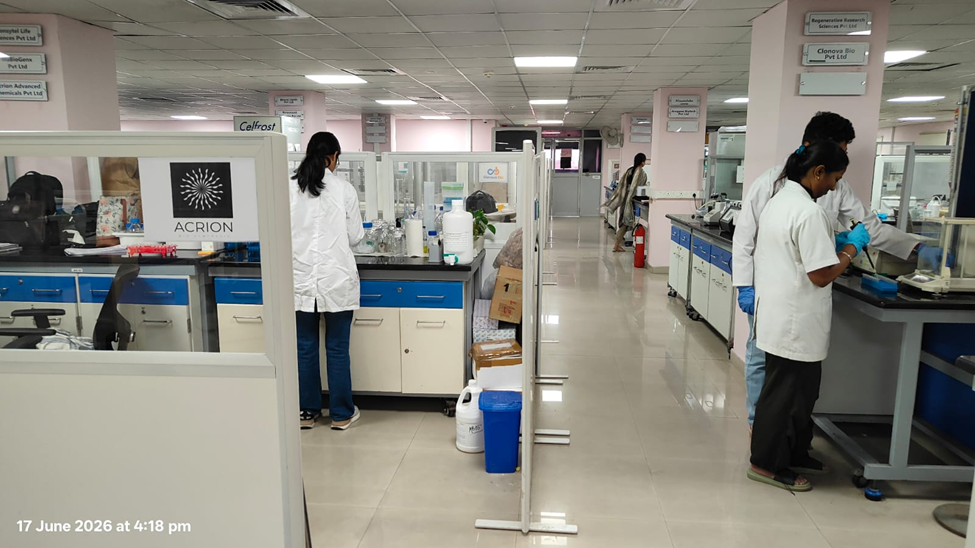
Different startups housed at AIC-CCMB accessing common facilities, PC: AIC-CCMB
Through mentoring, these incubation centres support in choosing the right business model among product-based manufacturing, research services, or hybrid offerings. Some may also help in identifying suitable funding strategies and obtaining initial grants. Early-stage biotech startups majorly rely on non-dilutive grants (capital support without losing shares), incubation supports or angel investors (affluent individuals who invest in early-stage startups).
Another kind of investors are venture capitalists (VC), who exchange equity/shares from the company for the funding. Startups rely on VC only when they start acquiring customers actively and plan to expand.
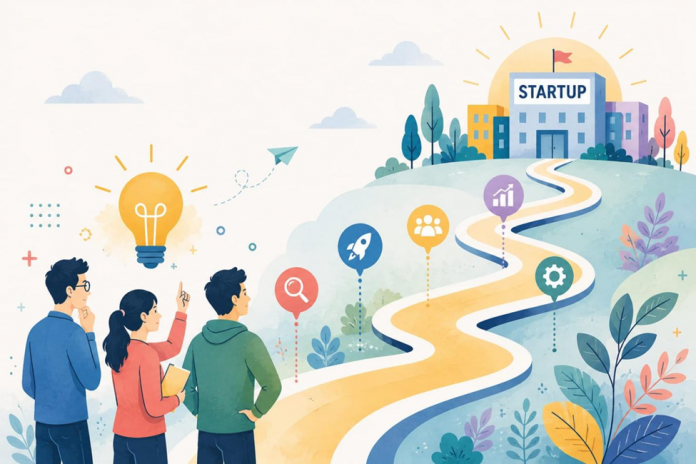
Crossing the Valley of Death
Despite promising ideas, estimates suggest that nearly 90% of new ventures fail within the first three years due to lack of funds. This period of being “scientifically interesting” but yet to be “commercially scalable” is called the valley of death. The lack of commercial scalability can be because of a lower Technology Readiness Level (TRL; a nine-point standardized scale). TRLs help estimate the technological maturity. Investors frequently use TRLs to evaluate risk and determine whether a technology is ready for commercialization.
During this stage, founders must carefully manage the cash flow and increase the sales, until the venture becomes self-sustaining. Equally important is recognizing when a business model is not viable. In some cases, adapting or pivoting a technology toward a different application can salvage and significantly improve its commercial prospects.
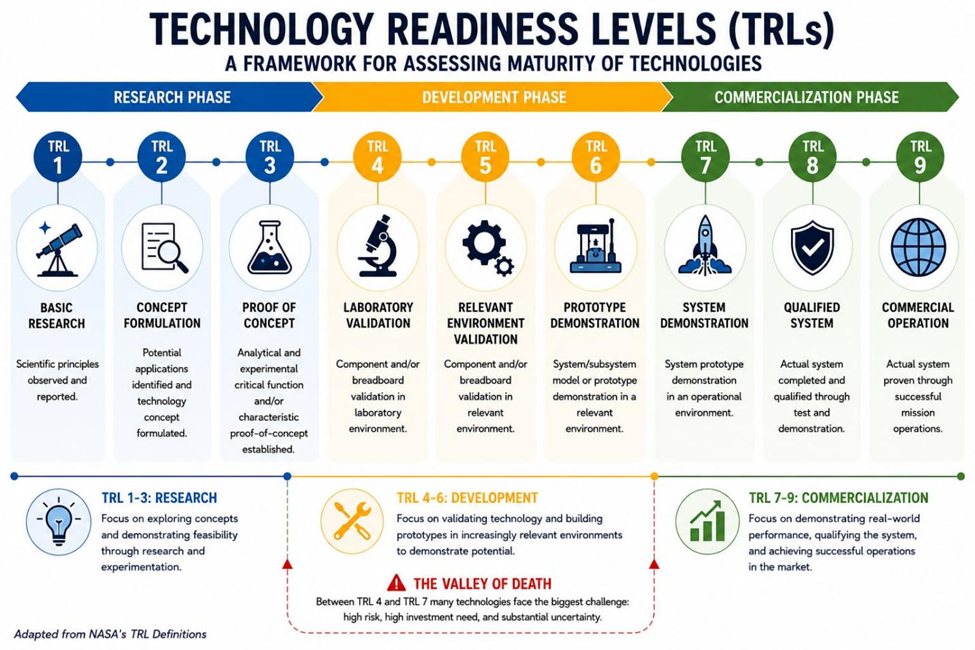
Image credit: Generated using Open AI
Where should scientist founders start?
Scientists are often motivated by curiosity and the pursuit of knowledge. But it is important for them to remember that many discoveries also have the potential to solve real-world problems. Some researchers begin with a clearly identified challenge and develop a solution, while others discover commercial opportunities only after making a scientific breakthrough.
Understanding entrepreneurship enables scientists to translate such innovations beyond publications, into products and services that benefit society. By wearing two hats, researchers can help ensure that their discoveries benefit society beyond the laboratory.
Regardless of the starting point, successful entrepreneurship often begins with identifying gaps in accessibility (what product is unavailable), affordability (is the product affordable for consumers), or application (what does the user need in the product), rather than exclusively pursuing radical innovations alone. Addressing these can help to pass the valley of death successfully.
An important distinction is understanding the difference between customers and consumers. For example, while patients ultimately consume medicines, the customers for a startup developing a drug may be pharmaceutical companies, hospitals, or healthcare providers. Understanding customer needs and constraints is essential for successful commercialization.
Consider specialized culture media used for cardiomyocytes (heart cells) research. Such products are often expensive because they rely on imports and lengthy supply chains. Developing a locally manufactured alternative can reduce costs, shorten delivery times, and improve accessibility for researchers. Protpure and HappyCellsBio are startups that produce indigenous lab consumables, thereby reducing import dependency and improving affordability for Indian research labs.
Furthermore, scaling solutions to address broader market needs enhances financial sustainability and reduces dependency on external capital support. It provides greater flexibility to reinvest in research and development (R&D) and supports long-term strategic goals. A case on point is ThermoFisher Scientific. By supplying widely used laboratory reagents, consumables, and scientific instruments, the company generated stable revenue that enabled continued investment in advanced biotechnology, genomics, molecular biology, by acquiring firms like Applied Biosystems and Invitrogen. Accquirng PPD, Inc. also helped them expand in the pharmaceutical services.
Having said all of these, the lesson is not necessarily to ‘always start small’, or reach for the low hanging fruits. Having a clear vision, and creating a path of technical and commercial milestones that progressively reduce risk is something that Moderna did. They focused on building a universal mRNA platform – programming human cells to make their own proteins to prevent/ fight disease. When the COVID-19 pandemic hit, they received substantial funding from VCs, pharmaceutical collaborations because of strong IP, idea of a scientific platform and exceptional long term vision helped them grow. These accelerated the validation of the mRNA platform and transformed Moderna into one of the most prominent biotechnology companies in the world.
The future of biotechnology innovation
Today’s biotech startups offer valuable lessons for future founders. Successful ventures often begin with a clearly defined problem rather than a technology alone. Incremental improvements in accessibility, affordability, or usability can create substantial impact, and scalability is often more important than technical complexity. Interdisciplinary collaboration is essential; no founder succeeds alone.
Looking ahead, the convergence of AI and biology, advances in synthetic biology, precision medicine, affordable research infrastructure, and climate-focused technologies will create unprecedented opportunities for biotechnology innovation. For aspiring entrepreneurs, these developments represent not only business opportunities but also a responsibility and a chance to a meaningful difference in the world.
Perhaps the greatest barrier to innovation is not a lack of ideas, but the hesitation to pursue them. Transforming scientific discoveries into real-world solutions requires confidence, resilience, and support from mentors, institutions, and the broader innovation ecosystem. As the boundaries between science and entrepreneurship continue to blur, researchers willing to test bold ideas and challenge convention will help shape the next generation of biotechnology and its contribution to human well-being.