
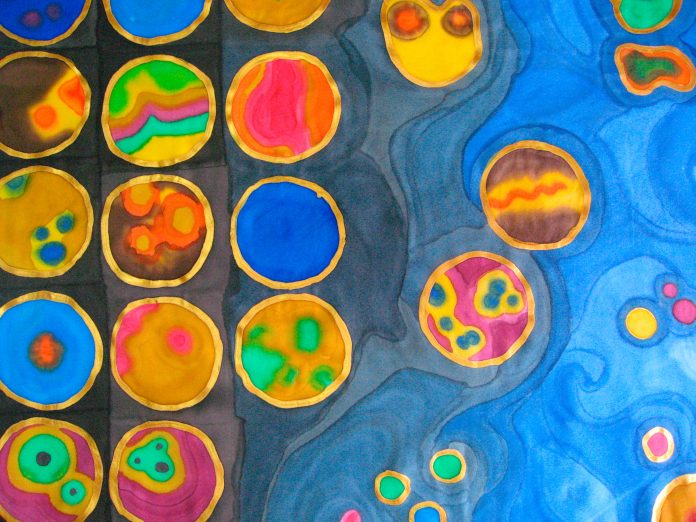
Credit: Origin of life. Odra Noel. Source: Wellcome Collection.
Imagine a time when the Earth was silent—a barren rock floating in space, devoid of breath and greenery. The transformation from that inanimate world to the living one we know today is perhaps the most profound event in history. This process is called abiogenesis: the theory that life didn’t just appear, but gradually emerged from non-living matter through natural chemical evolution. It is a story of how the universe, using nothing but simple chemicals including water, energy and most importantly time, slowly organized itself into something capable of survival. To understand this incredible journey, we must travel back to the very beginning, to the infancy of our planet.
Life is estimated to have started on earth approximately 3.5 to 4 billion years ago, during the volatile Hadean and early Archean eons. The early Earth was a hostile environment, characterized by an atmosphere lacking oxygen and dominated by gases such as methane, ammonia, hydrogen, water vapour, all while being constantly bombarded by intense ultraviolet radiation and lightning. Yet, it was within this chaotic crucible that the first critical step toward life began: the synthesis of organic building blocks from inorganic precursors. The famous Miller-Urey experiment in 1953 provided the first experimental proof of principle for this phase, demonstrating that subjecting these gases to lightning and heat could successfully synthesize amino acids, the fundamental components of proteins, from simple molecules like water and methane.
However, the creation of simple individual components of biomolecules is only the beginning; life requires complex polymers like DNA, RNA, and proteins to function. In the vastness of the primordial ocean, these building blocks must have faced a significant hurdle known as the “dilution problem,” where they would simply drift apart in the water rather than link together. To overcome this, it is hypothesized that mineral-rich rock surfaces, perhaps located at the edge of tidal pools or hydrothermal vents, acted as chemical scaffolds. These surfaces could adsorb monomers, effectively concentrating them and catalyzing their polymerization into more complex chains.
As these chemical systems became more complex, a critical “chicken-and-egg” paradox emerged regarding the nature of the first self-replicating life form. DNA holds the genetic blueprint for life. But it is chemically passive and cannot replicate itself without the aid of complex catalytic protein machinery, such as polymerases. Conversely, these proteins cannot be synthesized without the instructions encoded within DNA. This creates a logical loop: if DNA requires proteins to replicate, but proteins require DNA to be built, how could life have possibly begun? Which of the two – a source of information or a building catalyst – must have come first?
Breaking the Loop: The RNA Solution
The widely accepted answer to this paradox lies in the unique dual nature of RNA. Unlike DNA, which is strictly utilized for information storage, or proteins, which are strictly utilized for catalytic activity, RNA possesses the capability to do both. This versatility forms the basis of the RNA World Hypothesis, which proposes that early life relied entirely on RNA for both genetic continuity and chemical catalysis. Like DNA, RNA is a nucleic acid composed of nucleotide bases and can store genetic information in its sequence, allowing “blueprints” to be passed from one generation to the next. However, unlike the rigid double helix of DNA, RNA is single-stranded and can fold into complex, three-dimensional shapes. These shapes allow RNA to function like an enzyme, creating catalytic molecules known as ribozymes.
The RNA World hypothesis solves the biological puzzle of “which came first, DNA or protein?” but it creates a new, chemical puzzle. RNA is a single-stranded biopolymer; each unit composed of a ribose sugar, a phosphate group, and a nitrogenous base. Building such molecule from scratch on the early Earth conditions would have been incredibly difficult as ribose is very unstable, it is very difficult to separate ribose from other sugars and also linking it precisely to phosphates without enzymes is chemically unfavourable and inefficient.
Because of this difficulty, many scientists believe RNA was probably not the very first step. Instead, they propose a “Pre-RNA World.” The idea is that simpler, tougher genetic molecules appeared first. Think of these molecules as a “rough draft” of life – they were chemically simpler and easier to build than RNA, but they could still pair up and pass on information. Eventually, these rugged molecules acted as a scaffold or template, helping the first RNA strands to form and eventually take over.
However, recent scientific breakthroughs show that making RNA might not be as impossible as we thought. Scientists used a new approach called “Systems Chemistry” to solve this problem. They showed that if you take very simple chemicals present on the early Earth—like cyanamide and glycolaldehyde—and expose them to UV light, they can react to form the building blocks of RNA (nucleotides) directly. This suggests that the “ingredients” for life didn’t need to be made one by one; they could have been made using some atmospheric gases and volcanic compounds in a natural environment.
Finally, there is the problem of stability. Even if you make RNA, it is fragile and breaks down easily in water. To solve this dilemma, new research points to a “Co-Evolution” or “Chimeric World.” This theory suggests that RNA didn’t evolve alone. Simple, short protein fragments called peptides likely formed alongside it. These peptides could bind to the RNA, acting like a protective shell to keep it stable. In this view, the story of life isn’t just about RNA; it’s about a partnership between RNA and primitive peptides helping each other persist from the very beginning.
Once RNA was finally established – whether it took over from a simpler ancestor or was stabilized by early peptides – the stage was set for the “RNA World” to begin. In this era, a specific RNA molecule could essentially store the code for its replication while simultaneously performing the chemical reaction to copy itself. The strongest evidence for this theory exists inside every living cell today. The ribosome, the universal machine responsible for making proteins, is itself a ribozyme. Crystallographic studies have shown that the ribosome’s core catalytic engine—the part that actually stitches amino acids together to build proteins is made of RNA, not protein. This suggests that protein synthesis could have evolved from a RNA-based process. Furthermore, many essential metabolic molecules, such as ATP, NAD+, and FAD, are actually modified RNA nucleotides, appearing as remnants of a metabolism that once relied on RNA building blocks.
Ultimately, the transition to true life occurred when these self-replicating RNAs (or RNA-peptide systems) became encapsulated within lipid membranes, forming protocells. This encapsulation allowed the RNA to create a distinct internal environment, subject to Darwinian evolution – a process where functionally beneficial molecular variations were selected, preserved, and passed on. Debates still continue, especially whether metabolic cycles might have preceded genetic molecules (as cited in the “Metabolism-First” hypothesis). But these experiments have not worked out in the lab. Therefore, the scientific consensus leans toward a scenario where RNA-likely aided by simple peptides bridged the gap between non-living chemistry and the first cellular life forms, eventually handing over data storage to DNA and chemical work to proteins for their superior stability and efficiency.